Trams in Barcelona
Posted: | Tags: transport rail tram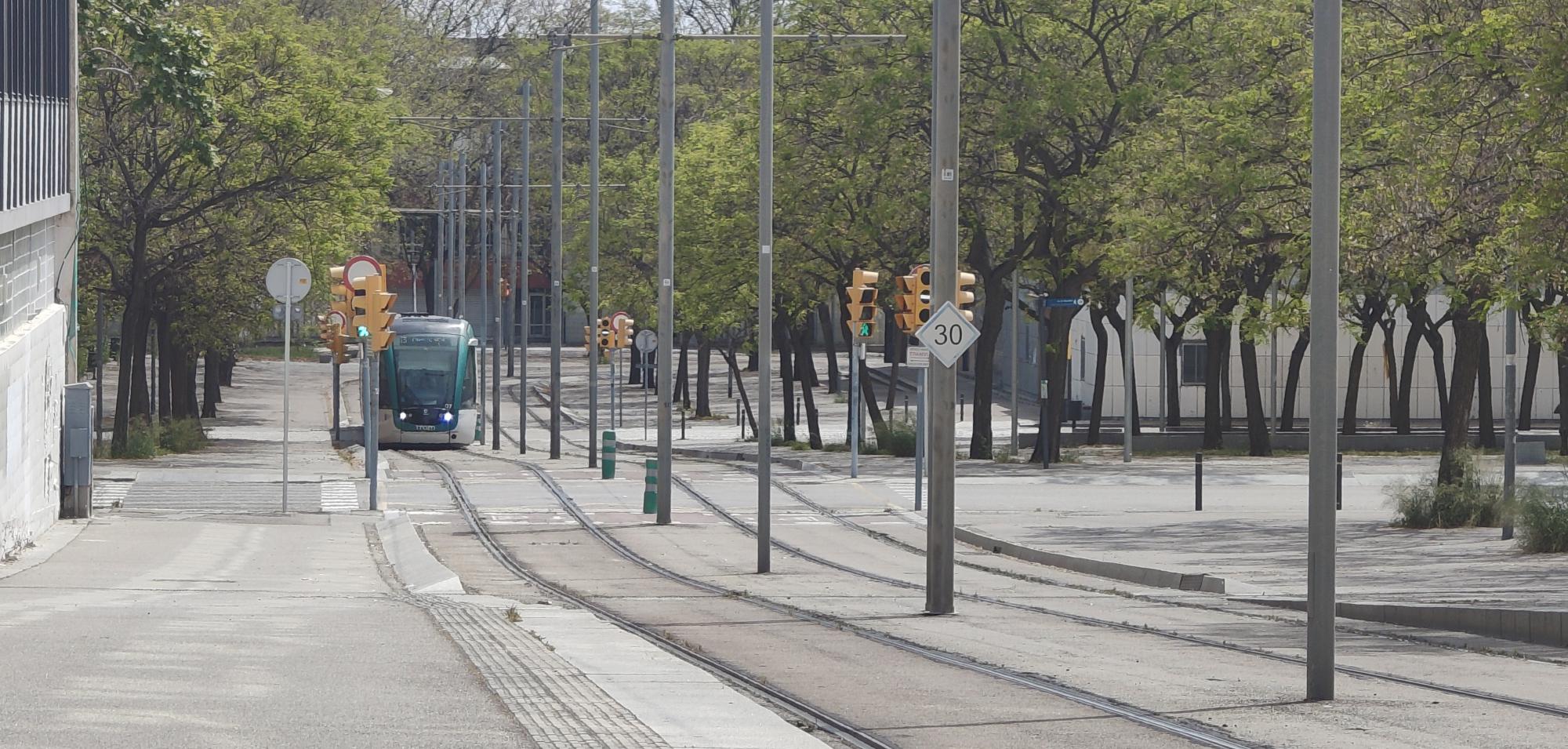
Like many cities, Barcelona started with a horse-drawn tram network, which then grew and was electrified before being decommissioned in favour of buses, private vehicles and the metro. Having not turned out so great, Barcelona then returned to the tram. I wrote about this same pattern in Luxembourg and Berlin, now it’s time for Barcelona.
The first tram network
The horse-drawn tram
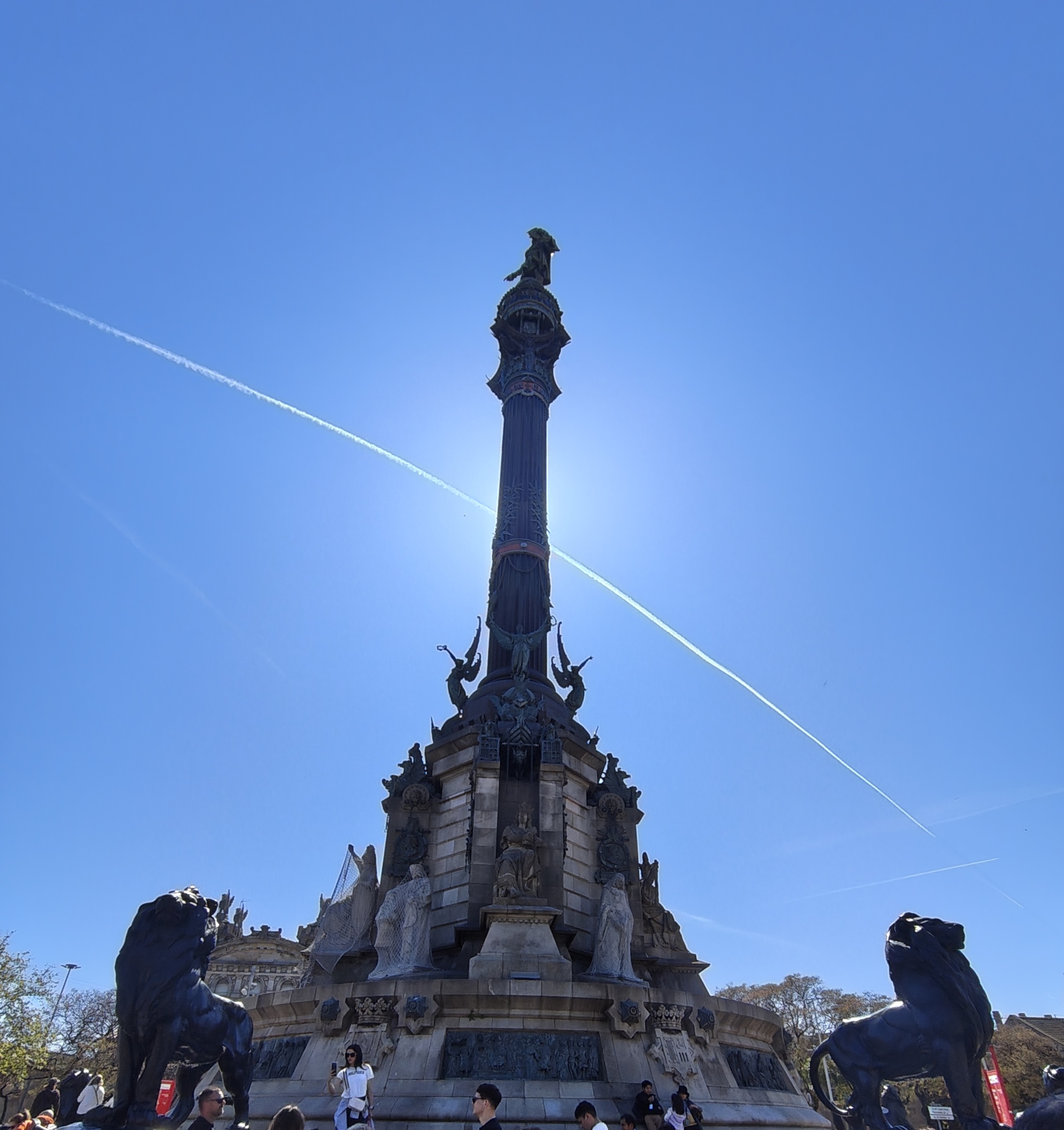
A monument to Christopher Columbus was constructed in 1888 near the Drassanes shipyards.
The first tram line opened on 27 June 1872, as Cerdà was hard at work implementing his plan to expand Barcelona using the infamous grid layout. The service connected the shipyards at Drassanes (Pla de la Boqueira) through la Rambla, passeig de Gràcia, and Gran o Major de Gràcia. It ended in Josepets by Plaça de Lesseps, in the neighbouring village of Gràcia. The project was promoted by businessmen Aleix Soujol and Eduard Biada, while the operation of the tram service was managed by the British Barcelona Tramways Company Limited.
The tram itself had a bottom and upper level connected through a winding iron staircase and was pulled by three to four horses. As the population increased, so did the number of lines that were built and soon other surrounding villages were connected to the network as well. These villages are all districts of the city of Barcelona today.
The planning, promotion, funding and execution of the tram, given the political climate in Barcelona at the time, is interesting in itself, and the blog El Tranvía 48 has done a good job documenting that among other fascinating stories.
Steam
In 1877, steam trams arrived when the Sociedad Anónima Tranvía de Barcelona al Clot y San Andrés1 swapped horsepower for steam. The route ran from Carrer de Trafalgar, near the Arc de Triomf, to Clot and Sant Andreu. Using steam allowed for longer journeys than were possible using horses. Despite being considered dangerous, nicknamed tramvia de foc - the fire tram - and an accident in Glòries killing a passenger and injuring many, steam proved to be very popular.
Electrification
Some twenty-five years after the introduction of steam, electric trams began to surface first from Urquinaona to Sant Joan d’Horta in 1901, and then by the end of 1902, more tests were conducted, and electric trams entered regular service. By 1907, the ring road around the old walls of the city was electrified.
The Spanish Civil War in the 1930s disrupted the tram network, although apparently the service gradually improved after 1939. Helping with the broken network were trolleybuses, which were first used in Barcelona in October 1941, by company Tranvías de Barcelona S.A.. These trolleybuses, called filobuses, ran on electricity using the overhead catenary.
Much like the horse and steam trams, the history of trolleybuses in Barcelona is quite extensive, and I cannot do it justice in this post. So, I will direct you to José Mora Martín’s website, Autobuses BCN, where you can find much more information about these vehicles and their deployment.
Barcelona on 1 March 1951 saw the first organised boycott under the Francoist Spain rule due to proposed price hikes of the tram. Strikes like these were prohibited after the war in the Spanish State. This worked, and the price hikes were later revoked.
As time went on, trolley buses took over from trams, but before the network could fully be handed over, trolley buses themselves were replaced by regular buses. In the same vein, electric trams continued to serve until 1971, when the last two lines, 49 (Drassanes and Horta) and 51 (Drassanes and via Júlia), were discontinued. The only survivor from this era was the Tramvia Blau, which was not owned by Tranvías de Barcelona. Located in the Sarrià-Sant Gervasi district of Barecona, the line goes from Pl. Kennedy to Pl. Dr Andreu. It was later taken over by the city in 1979 and operated until 2018 when it was closed for “modernization works on its infrastructure”. It’s still closed 8 years later.
The modern tram network
In the late 1980’s, l’Entitat Metropolitana del Transport (EMT) studied the possibility of a tram along Avenida Diagonal, connecting the city of Barcelona. Later in 1997, EMT commissioned l’Agéncia Barcelona Regional to write a concession that integrates several other studies done for the tram. Around this time, a pilot between Plaça Maria Cristina and Carrer Entença was set up, transporting passengers along the 650-metre track using Alstom TFS and Siemens Combino trams. A year later, l’Autoritat del Transport Metropolitá (ATM) was delegated the task of planning the tram along the Diagonal-Baix Llobregat corridor. Not long after, on 27 April 2000, ATM awarded the contract to construct Trambaix to a consortium of Alstom and Fomento de Construcciones y Contratas (FCC). Alstom would provide the rolling stock, signalling and power supply and FCC with the construction and catenary installation.
The first service of Trambaix was inaugurated on 3 April 2004. The service connected the city of Barcelona with Sant Joan Despì, and L’Hospitalet de Llobregat using 19 Alstom Citadis 302 trams. The service launched despite several accidents during the test run.
A year later, Trambesòs’ first service began operation on 8 May 2004. Yes, this was a second tram network, but on the opposite side of Barcelona. Trambesòs was included in the same study as Trambaix, but not in the initial funding for construction by ATM. This new line connected Avenida Diagonal in the city of Barcelona with Sant Andrià de Besós.
Trambaix
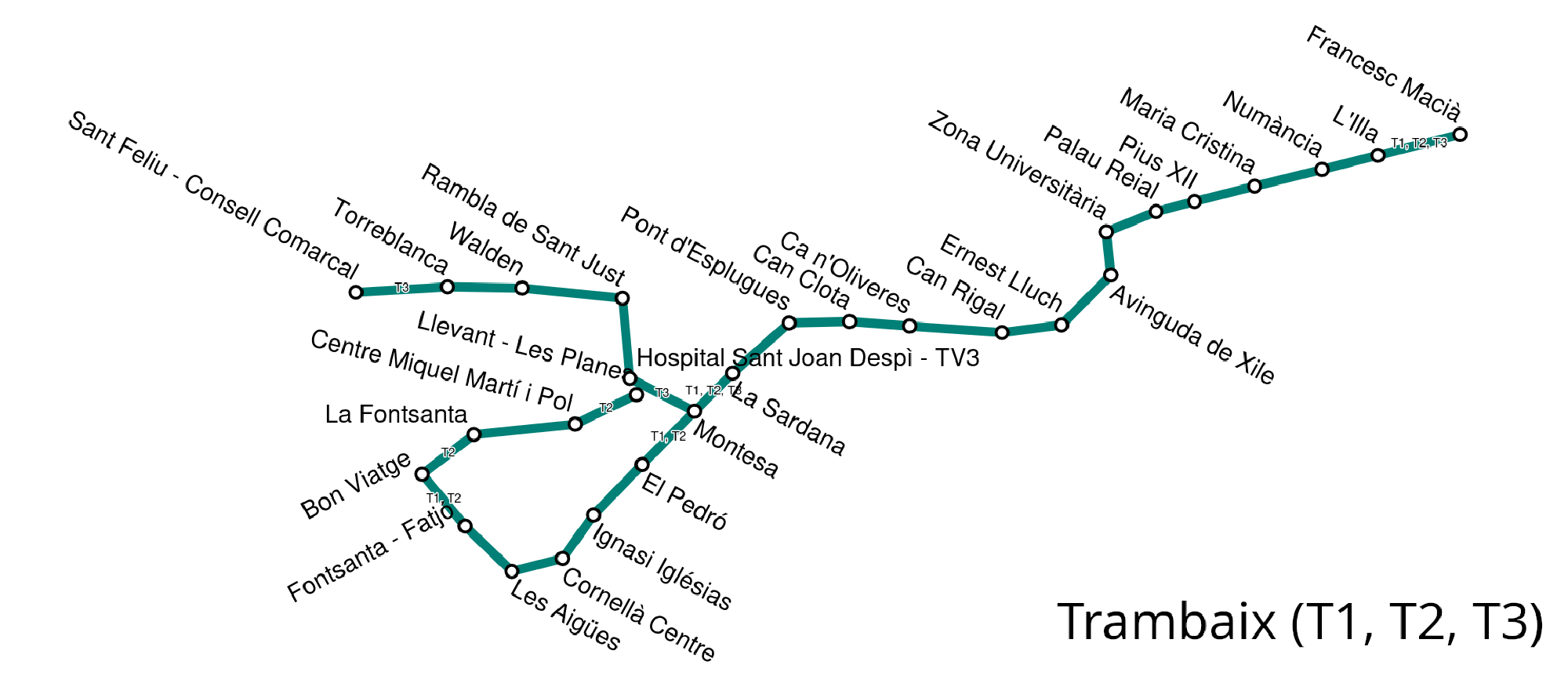
Today, Trambaix has roughly 15 kilometres of track with 29 stops, with interchanges to the bus, metro and train network. This network has three lines, T1, T2, and T3, which share the same track on parts of their route.
T1 and T2 share most of the same route, from Francesc Macià on Avenida Diagonal to Bon Viatge in Sant Joan Despí, from there T2 continues further to three more stops: La Fontsanta, Centre Miquel Martí i Pol and Llevant - Les Planes. Both these lines provide connections to the L5, L3 and L9 Sud metro, and the Rodalies train network.
T3 shares some of the same stops as the T1 and T2 lines, starting at Francesc Macià on Avenida Diagonal and splitting off at Montesa, where it then goes toward Sant Feliu de Llobregat, travelling through Hospital Sant Joan Despí. The connections to other forms of transport are provided through the only shared part of the line with T1 and T3, these include interchanges to metro lines L5, L3 and L9 Sud.
Trambesòs
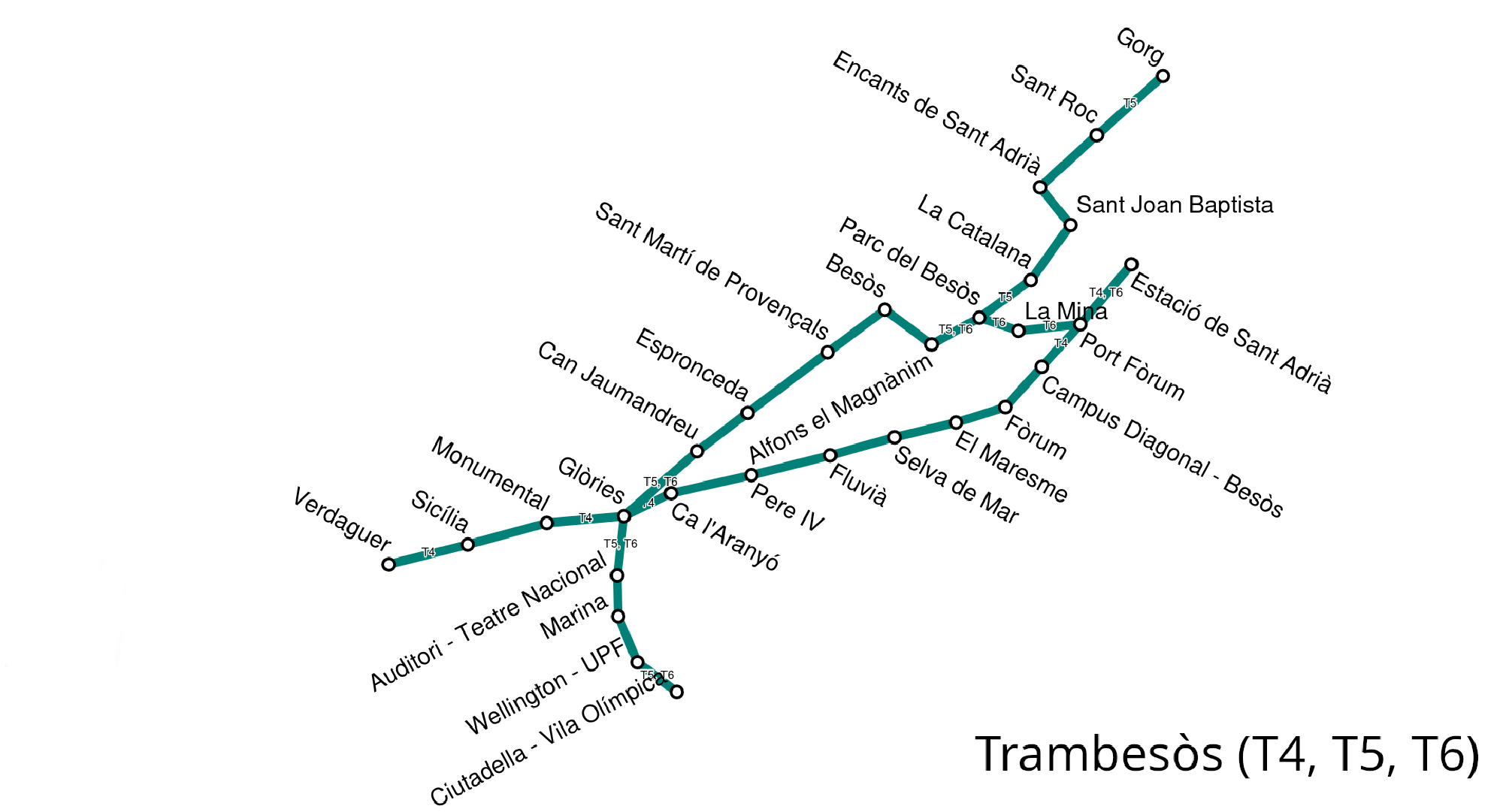
The Trambesòs network includes lines T4, T5 and T6, which also have a total of 29 stops and is just shy of 16 kilometres of track.
The T4 line is the only one out of these three that starts at Avenida Diagonal from Verdaguer and connects Barcelona with Sant Adrià de Besòs, where it terminates at Estació de Sant Adrià. This route provides opportunities to transfer to the L1, L2, L4, and L5 metro lines along with the Rodalies train network at its terminus.
Line T6 also connects Barcelona with Sant Adrià de Besòs but starts at Ciutadella | Vila Olímpica, goes to Glòries and then continues to Besós through Gran Via and ends at Estació de Sant Adrià via Fòrum. This route features connections to the L1 and L4 metro lines, and the Rodalies network through the station at Sant Adrià.
Lastly, T5 connects Barcelona with Badalona through Sant Adrià de Besòs. This line shares most of its stops with T6, starting at Ciutadella | Vila Olímpica, going to Glòries, and then travelling along the Gran Via. The T5 splits from the T6 at Parc del Besòs, where it crosses the Besòs river on Cristòfol de Moura, and enters Sant Adrià which then travels through and ends at Gorg in Badalona. This route provides interchanges at the metro lines L1, L2, L4, and L10 Nord.
Combining both networks
In order to connect both networks four options were studied;
- A route along Avenida Diagonal along the surface.
- An underground segment between Francesc Macià and Carrer del Bruc along Avenida Diagonal. This alternative avoids changing the busiest sections but also involves the most construction work.
- A route on Carrer del Comte d’Urgell - Carrer de Provença and Avenida Diagonal. This tram route would take the second exit at Plaça de Francesc Macià, go down Carrer del Comte d’Urgell and turn left on Carrer de Provença, which eventually connects back to Avenida Diagonal by the terminus of the Trambesòs network. This would include sharing the road with other motor vehicles, bicycles and pedestrians.
- Use an electric bus between the termini of each network. What’s the point of a tram, am I right?
The first option was selected as the best possible alternative, offering the shortest route between the two networks and also improving the accessibility of Avenida Diagonal along the way by reducing private vehicle traffic, relieving strain on the busy horizontal bus routes and providing transfer opportunities to the metro.
On 9 November 2024, three new stations along Avenida Diagonal were inaugurated: Monumental, Sicilia and Verdaguer. These stations are served by the T4 line today. They also bring us one step closer to combining both the Trambesòs and Trambaix networks. The link between them, along Avenida Diagonal from Verdaguer and Francesc Macià, is waiting for the avenue to be urbanised. This will include improvements to the sewage line, wider and separate bicycle lanes, and widening the pedestrian pavement at the expense of fewer car lanes. The final approval for reurbanisation of the avenue and the construction of the water collector was given on 17 March 2026 and is awaiting funding.
Rolling stock
Both tram networks use Alstom Citadis 302 trams, 19 allocated to Trambaix and 18 to Trambesòs. These were manufactured by Alstom at their industrial centre in Santa Perpetua de Mogoda, Spain. The trams are housed and maintained at depots in Sant Joan Despì, for Trambaix, and Sant Adrià de Besòs, for Trambesòs.
To improve capacity along the Trambaix routes, four new Citadis 302 trams were acquired in 2011, totalling 23 trams. Today they run at four-minute intervals on the common trunk. In 2025, the Trambesòs network got three new Citadis 305 trams, bringing their total to 21. The entire fleet is all low-floor, allowing for level entry and exit from the platform and has 5 parts with 4 double doors, wide enough for wheelchairs, in the middle and two single doors at either end.
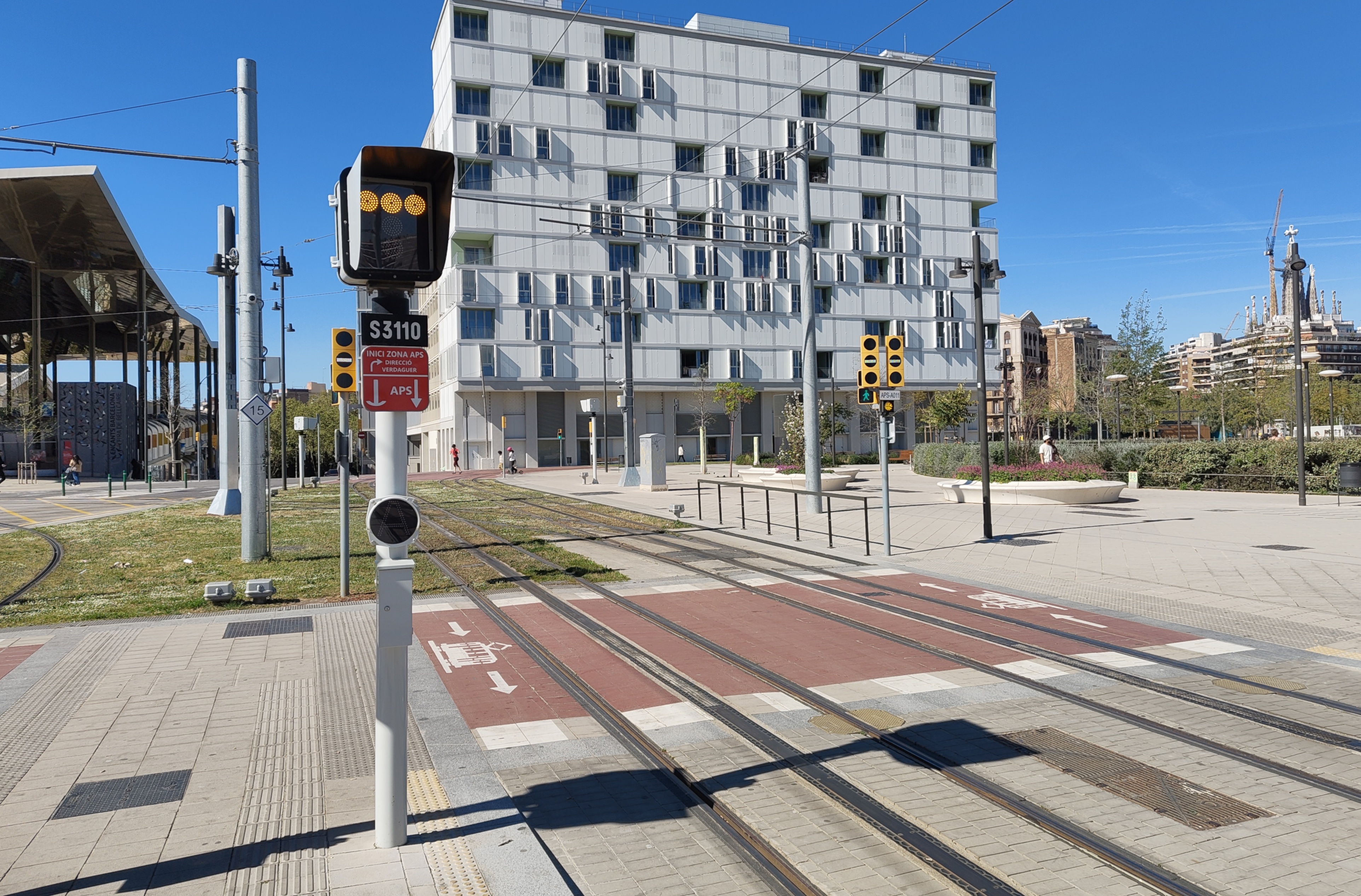
Signage indicating the start of the APS zone.
All trams are equipped to use the 750V overhead catenary wires throughout the network, except for the newest extension between Glòries and Verdaguer. Stops on this 1.8km route use Alstom’s Aesthetic Power Supply/Alimentation Par le Sol (APS), which is a ground-based feeding system that works on a third conductor rail. This rail is divided into 11-metre segments that becomes energised when under a tram. The current 18 Citadis 302 trams on the Trambesòs network were adapted to use APS, and the new 305 trams came with this feature installed. When at the Glòries stop, you can see the trams raise or lower their pantograph depending on whether they’re entering or leaving the APS zone.
It’s clear there’s going to be more changes in the upcoming years, construction, new trams and changes in schedule to accommodate the growth and new connections. I’m looking forward to it.
It’s hard trying to find sources for this company other than what’s written by spanishrailway.com or El Tranvia 48. Anyone know more? If so, please reach out. ↩︎