Veghel's buses and the disused rail
Posted: | Tags: transport statusThis weekend, Stichting Industrieel Erfgoed Meierijstad (SIEMei) will inaugrate the work done at the marshalling yard in Veghel, connecting the tracks that were once part of the Duits Lijntje (German line) running from Boxtel to Wesel. Over the years the foundation has acquired various equipment including steel carriages used in the 20th century, the Zuid-Willemsvart lifting rail bridge that was dismantled when the canal it was used on was widened and the SIK 347 shunter. SIEMei has done a lot of work to preserve the history of the German Line that was built in the 1870s and saw use even after disruptions during the world wars. Both passenger and freight services fizzled out by the turn of the century.
Reading about this again reminded me of when I used to commute to Veghel a few times a month for work, only a few years ago. It has nothing to do with the German Line or SIEMei, but I thought it was worth sharing my commute to Veghel’s industrial estate and how it could be just a bit better.[¹]
Getting to Veghel today by public transport involves arriving at either ’s-Hertogenbosh (Den Bosch) Centraal Station or Eindhoven Centraal Station and then taking the bus 306 or 305, respectively. Bus 306 takes roughly 30 minutes, while the 305 takes a little over 20 minutes to the Veghel Corridor, which is in the industrial part of the city. These same buses also travel towards the centre of Veghel.
The bus from Den Bosch departs every 15 minutes throughout the day, and the bus from Eindhoven also maintains the same frequency but squeezes two extra buses in the morning, that’s one every 10 minutes, and three extra buses in the late afternoon, one every 7.5 minutes. That’s impressive.
My trips to Veghel had me travelling through Utrecht, so ’s-Hertogenbosch Centraal Station was my point of entry. I usually arrived later in the morning and would leave in the evening during rush hour. The return home was the worst part. The Veghel corridor gets jammed up with trucks and private vehicle traffic in the evening, which also blocks the buses, as most of the route does not involve dedicated bus lanes. This leads to delayed buses and overcrowded bus stops. At times, I’d jump on whichever bus I could, even if it meant a longer train journey home from Eindhoven.
This problem wasn’t unique to me, as a lot of the other people I spoke to who commuted there more regularly would choose to leave earlier in the day or later in the evening to avoid the rush. Many also opted to use their own private vehicle, as sitting in their car during the traffic was more comfortable than waiting at the bus stop or stuck in traffic shoulder to shoulder on a crowded bus. I can’t blame them, but this only makes the traffic situation worse.
The Dutch Railway, NS, also recognises this problem.
North Brabant is reaching the limits of what its mobility system can handle. […] It is expected that Brabant will become busier on roads, trains, buses and cycle paths, with travellers covering longer distances. […] Uden and Veghel do not have a station. These towns need better public transport connections. Improved links are needed with ’s-Hertogenbosch, Oss, Nijmegen and Eindhoven to strengthen the region. We are exploring a fast bus service allowed to use the hard shoulder during traffic jams: Bus Rapid Transit (BRT).
Recently, VDL Citea LE-135 buses were ordered and are now in use by Arriva on this route. These buses can carry a total of 89 passengers. Back when I did this commute, Volvo 8900 LE buses were used, and the passenger capacity varies depending on the source, but a total of 85 seems correct. Unfortunately, that’s only a 4.7% capacity increase with the new buses. If dedicated bus lanes could be secured, ensuring the service becomes more reliable under the current schedule, that would still be a win in my books.
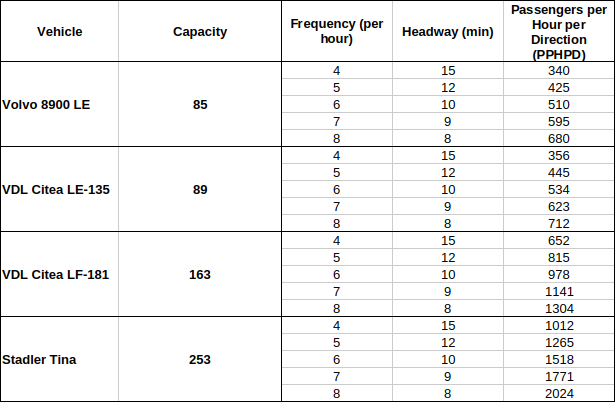
Comparison of the passenger per direction per hour figures across the Volvo 8900 LE, CDL Citea LE-135, the articulated VDL Citea LF-181 and the tram Stadler TINA.
However, given that passenger numbers are expected to increase, as NS suggests, lengthening the higher frequency service to off-peak hours might work if the passenger traffic is spread out. Now speaking hypothetically, I thought I could dream about a scenario where the bendy VDL Citea LF-181 buses were purchased instead. These are new buses used by GVB in Amsterdam capable of carrying a total of 163 passengers. That results in transporting 652 passengers one direction per hour using the base 15-minute service, which is almost double what the current buses are capable of.
While we are still dreaming, if tram service were introduced from ’s-Hertogenbosch Centraal Station to Uden via Veghel, or even from Den Bosch to Boxtel and then Uden along the same route the German Line would have gone, we’d be looking at transporting a lot more people. As a benchmark, I took the recently purchased Stadler TINA trams for use by HTM in the Hague. These trams can carry a total of 253 passengers, running every 15 minutes, that’s 1012 passengers per hour per direction. With a maximum speed of 70 km/h, Boxtel and the marshalling yards, now renovated by SIEMei, are 16km apart. Using an optimistic approximation with a direct route that’s a little over 13 minutes. In reality, the tram would serve some passengers in Boxtel and Schijndel, which would bring its time up to 20-30 minutes, equivalent to the buses. Regardless, dreaming is entertaining.