Ground-level power supply for trams
Posted: | Tags: transport rail tramMost trams you’ll encounter today run on electricity using an overhead contact system, or OCS for short. This usually includes one wire, called the contact wire, powered by feeder stations providing DC voltage, which is “collected” by a pantograph connected to the roof of a tram. This provides power to the tram while it’s moving or standing still.
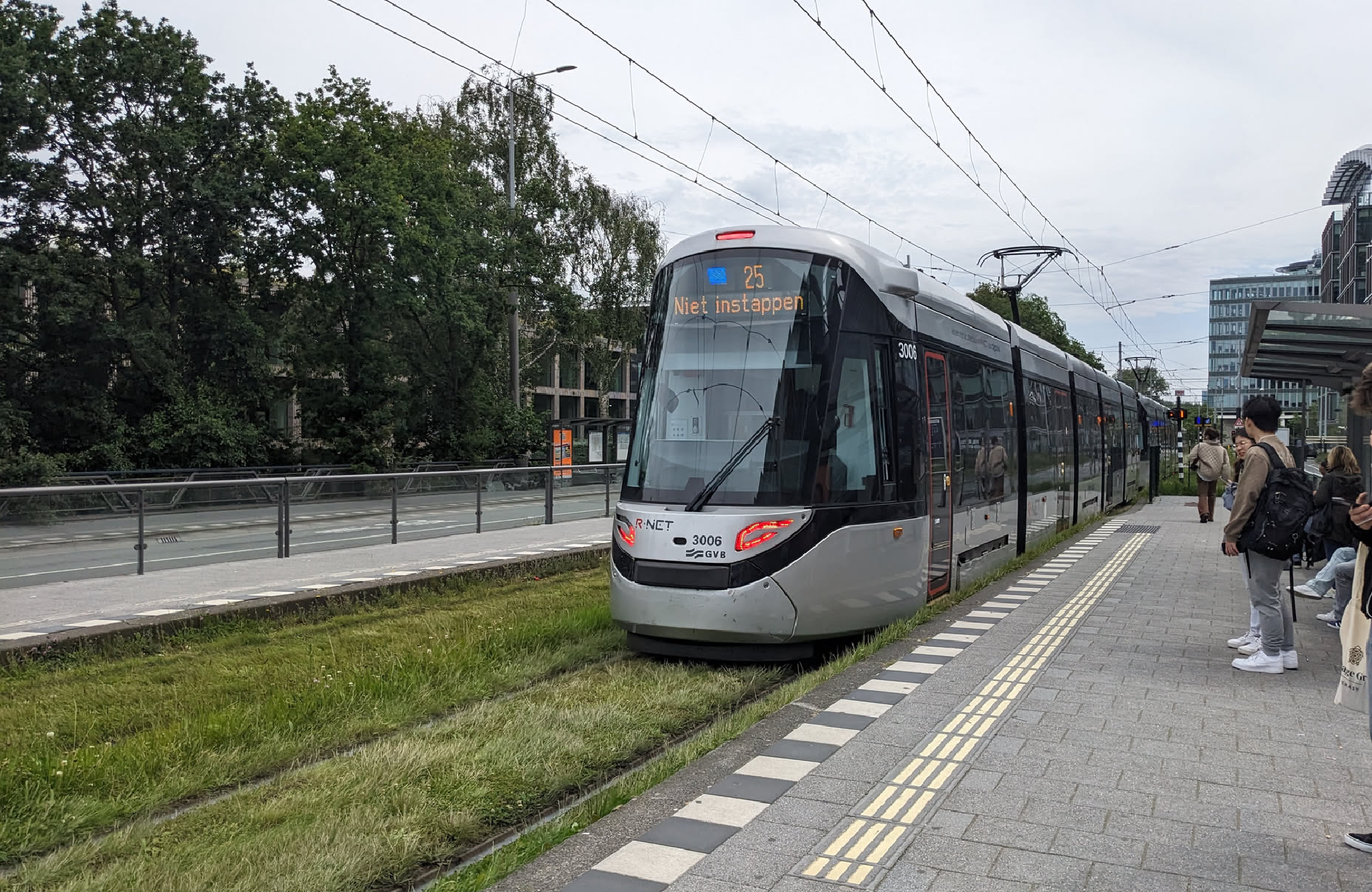
A GVB 15G tram (CAF Urbos 100) at Amsterdam Zuid.
Development of the overhead contact system first began towards the end of the 19th century as operators switched from horse-power (literally) or steam to electricity. OCS eventually made its way into mainline rail systems, thus transporting passengers and freight longer distances. If this topic is something you’re interested in reading more about, I’d recommend Garry Keenor’s book, Overhead Line Electrification for Railways.
Most tram electric systems today use 750V DC to power their equipment, although you may also encounter some 600V DC-powered trams among other odd voltages. This is enough to power the vehicles up to 70-80 kilometres per hour and account for the frequent acceleration and deceleration cycles required for close stops and while navigating traffic.
Over the years, there have been academic and industrial efforts to provide equally environmentally sustainable alternatives to the overhead contact system, some more viable than others. These usually boil down to powering the tram using ground-based systems, storing energy on the tram itself, or generating electricity on the tram. The reasons for these alternatives usually stem from OCS being seen as an eyesore in certain parts of the city, or because it cannot be installed under low bridges or in tunnels. Now, while I initially intended to document some examples of each of these alternatives, the post would have grown too long, so I chose instead to focus only on ground-level power supply systems, my most recent obsession.
Ground-level power supply systems usually entail a third rail which provides power to the vehicles using a conductor placed alongside or between the rails of the track. They’re already used on some metro networks; this avoids having to widen tunnels to accommodate OCS and works well for a closed system since passengers won’t get electrocuted with a live rail on the tracks. When it comes to trams, this method of providing power has been used and experimented with for decades, but the options are very limited.
Alstom Aesthetic Power Supply (APS)
The first variant we’ll look at was originally called Alimentation Par le Sole, which translates to feeding through the ground, I think. It’s now marketed by Alstom as Aesthetic Power Supply, obviously playing into the image that OCS can be seen as unappealing.
This solution involves installing a third rail between the tracks, which is divided into 11-metre segments. Eight metres of this segment are conductive, and the last three are insulated to join with the next 11-metre segment. The conductor is only energised when directly under the middle of the tram. This is triggered through a digital radio exchange between the ground element and the vehicle. Power is collected by two pick-up shoes on either side of the non-motorised bogie at the centre of the tram. All these precautions are in place to ensure other road vehicles or pedestrians do not come into contact with the 750V DC the system can provide. The power supply for APS are installed 22 metres apart.
First installation
Bordeaux was the first city to test APS with their Alstom Citadis 302 and 402 trams in 2003. At the time APS was developed by Innorail, a subsidiary of Spie Enertrans, this solution was later sold to Alstom. The network in Bordeaux includes a mix of OCS and APS power, which was chosen to preserve the historic image of the city. In 2004, the tram network started serving passengers and is still in operation today using APS in 14 of its 44-kilometre network.
There were initial problems, such as short circuits due to objects on the track and faulty cabling, which were gradually resolved. However, issues with the pick-up shoes that were seen in the early years still surface today. These could be caused by faulty shoes, wear during regular use, wear when switching between APS and OCS supply, debris, or misaligned APS segements.
Steady adoption
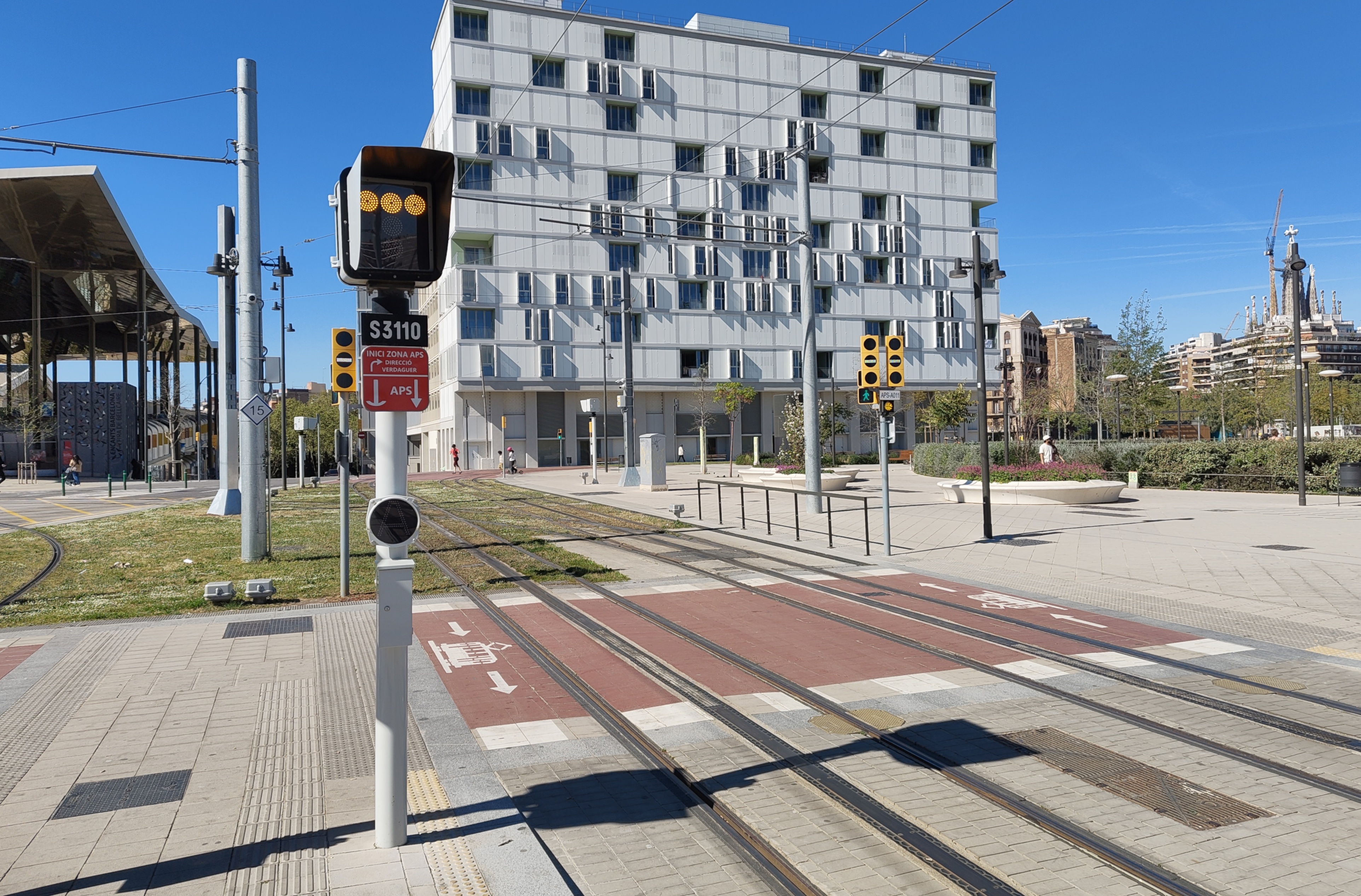
Signage indicating the start of the APS zone at Glòries, Barcelona. The conductor is also visible inbetween the two rails.
Today, APS has seen deployments in 11 cities to complment existing OCS instllations, except for Dubai. In 2013, the Dubai tram was the fourth city to use APS and it does so exclusively without any OCS along its 14.5-kilometre route. Alstom also mentions changes were made to the solution to adapt it for temperatures over 50°C, high humidity and sand.
The most recent city to install APS was Barcelona in November 2024 with the inauguration of three new stops extending its Trambesòs network. All of the 18 Citadis 302 trams used on this part of the network through the OCS were adapted to also use APS. In 2025, three new Citadis 305 trams were acquired, which came with this capability already included.
Ansaldo TramWave
Another variant of ground-level power supply for trams is TramWave, an iteration of Ansaldo’s STREAM which was designed for buses.
TramWave includes a contact line that is embedded between the rails, made up of 3- or 5-metre-long modules. Each of these modules contains the components required to form the bulk of the power supply, and is designed to be interchangeable if one fails, reducing the cost of maintenance. The pickup shoe that makes contact with the conductor is small enough to fit within the bogie. While this solution was designed for the Ansaldo Sirio tram family, it was advertised to fit other trams as well. The shoe is placed on a pantograph that is lowered to meet with the conductor and uses magnets to attract the power element, causing it to be energised. This ensures only the sections under the tram are energised with 750V DC. The marketing material also claims there are electro-mechanical fail-safes if the section remains energised after passing the pickup shoe.
The system was tested on a 400-metre track at Ansaldo’s Naples factory and later in public on a 600-metre part of Via della Stadera in Naples. Thanks to Google Street View we can see TramWave was installed sometime between December 2009 and August 2012 and was removed between May and August 2016. I was also able to find a YouTube video of a tram running at night using TramWave uploaded on 9 September, 2011.
First passenger deployment
Despite these tests both at the factory and in public, TramWave was scheduled to be used for the first time in passenger service when Ansaldo, currently Hitatchi Rail, signed a contract in 2012 with CNR Dalian, currently known as CRRC Dalian, a Chinese rolling stock manufacturer. The system was to be used in 10 Sirio trams in Zhuhai, China. The construction of the nearly 9-kilometre line began towards the end of 2013, a year prior to the arrival of the first tram from Italy. It then took three years before TramWave was adequately adapted for passenger service.
There were issues with supercapacitors that couldn’t hold a charge when running over switches, among other problems. CRRC worked with Ansaldo to rectify the issues, and the tram was able to enter passenger service on 13 June 2017. The fleet included two Italian-built Ansaldo Sirio trams, eight imported and assembled trams, and two that were manufactured within China itself.
Passenger service only lasted four years when line was suspended in 2021 as TramWave continued to have problems; this included five large-scale power outages and 11 major technical upgrades. During this time, the tram was also involved in five collisions and only had 8 out of the 12 trams operational with the others missing replacement parts. To top it off, the line saw low ridership levels, roughly 5% of its intended capacity.
TramWave’s deployment in Zhuhai was the only public passenger service this system saw, and as of 2021, it is no longer in use.
With all that being said when it comes to ground-level power supply Alstom APS has the upperhand, there was some experiments with powering lorries on the road with similar technology. Apart from this, a popular alternative to OCS is storing energy on trams, whether through supercapacitors like CAF’s ACR (Acumulador de Carga Rápida) or through batteries. Maybe I’ll write about that some day.